





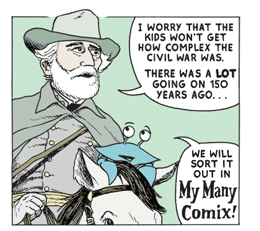








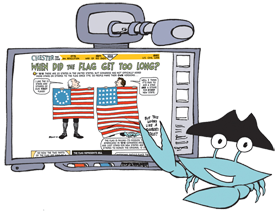
Comic books that bring history to life!
|
|

|
 |
||
 |
"Love Chester Comix for history. So much better than a dry textbook. The kids can remember the history better. And the comics mention details not often found in most history books." Pamela H., homeschooling parent |
 |
 |
||
Welcome to Chester Comix! Inside this site you'll find fun samples of the way Bentley Boyd uses comix to spark interest in history for reluctant readers! Check what he's drawing now, go with him to weird historical sites across the country, or download a coloring page and put your own words into his drawings! This home page features my most recent news/blog entries. Learn more about my blog. Have fun! --Bentley Boyd
Newsweek piece: What's wrong with boys in school?
September 10th, 2008
Here’s a quick hit that I’d love to hear your thoughts on. It’s a Newsweek piece that asks: are boys really so much less attentive than girls, or have we built an educational environment that is stacked against them?? I’ve come to the latter conclusion through my work with Chester Comix, my raising of my own two boys and my 10 years as a Cub Scout leader. Boys are rarely allowed to be boys anymore – the world is too structured and the concerns for safety have boxed them in. I think there’s a direct link to the rising child obesity and shortening attention span as the elementary-age boy spends more and more time “safely” inside, playing video games. Because they are the main audience for my books, I worry about them and hope we can carefully examine the long-term effects of the decisions we make a parents, educators and community activists.
Tags: Bentley Boyd, boys, Chester the Crab, education, graphic novels, testing
Posted in History Teacher | 1 Comment »
Comic book review: "Buddha: Kapilavastu," by Osamu Tezuka
September 8th, 2008
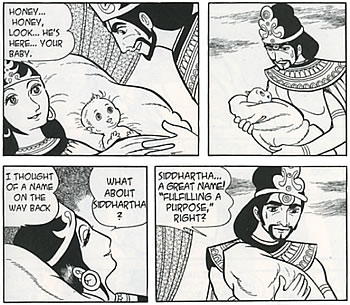
AGE APPROPRIATE: 11th grade and up (nudity and violence)
COLOR: no
PAGES: 400
I’ve spent a lot of my free reading time this summer digging into ancient India. One of the biggest school districts in Virginia has begun to teach ancient India to elementary students, and I’d like to draw a comic book about it this fall. As I have waded through library books and old National Geographics, I also looked for any other graphic novels on the subject.
I found an 8-part epic about the life of Buddha, written and drawn by Japanese manga forefather Osamu Tezuka! I’m not a fan of manga comix, so this was a chance to learn not only about the life of the founder of Buddhism but also to try swimming in a form of comix that is very popular with American teens.
There is a lot of vitality to Tezuka’s storytelling. He’s called “the Japanese Walt Disney,” and “Buddha: Kapilavastu,” the first of his 8-volume series, has a lot of action and silliness – in many cases the animals LOOK like they came from the Walt Disney studio. It amazes me as a cartoonist that even within a scene or even one panel Tezuka draws some characters seriously and others in very cartoony fashion. He even puts himself into some panels — with scribbles over his head identifying himself! The unevenness between his panels showing the scenery of India and panels showing goofy sentry jokes and panels dropping modern references make for a strange ride. And American audiences may be unsettled by the casual nudity of a mother and a small boy or the violence (blood is shown black since the comic is not in color). But maybe this all-but-the-kitchen-sink approach is the appeal of manga – Tezuka certainly uses all the elasticity of the art form (sometimes characters bounce off the panel borders or break them into pieces).
But if it’s good manga, does that make it a good telling of the life of the founder of one of the world’s great religions? The person who becomes Buddha is only born in volume 1! He appears on only a handful of the 400 pages, in only two of the 12 chapters. So I learned much more about Tezuka as an artist than I did about the historical Buddha. The rest of this first volume is filled with the antics of fictional characters — some of whom don’t survive this volume and so have no impact on the life of Buddha. Some of their stories deliver messages about the caste system in India, but it’s also clearly filler — Japanese manga comix are often published weekly, so there’s much more volume to their stories than you find in American comix.
So the bottom line is: do I think the path to enlightenment can be found on my way to paying $15 for each of the next seven volumes in the story????
Tags: Bentley Boyd, Buddha, comic book, graphic novel, history, India, manga, Osamu Tezuka
Posted in Graphic Novel Review | 1 Comment »
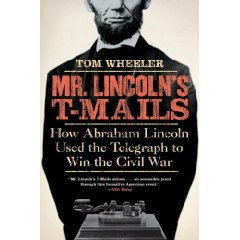
Book Review: Mr. Lincoln’s T-Mails by Tom Wheeler
August 29th, 2008
I enjoyed all the comparisons between Barack Obama and Abraham Lincoln made at the Democratic National Convention this week. If anything, Lincoln was LESS experienced at the time of his election than Obama is now: Lincoln had only one 2-year term in the House of Representatives and was a complete dark horse candidate at the Republican convention in the summer of 1860 and a shock to the East Coast establishment when he got the nomination.
Get ready for a lot more Lincoln – next year is the bicentennial of his birth, and a nationwide commemoration of the 150th anniversary of the Civil War will also gear up next year. There’s going to be a lot of blue and gray around, and I’m preparing to do a comic entirely on Honest Abe!
As research for that, I just finished reading Tom Wheeler’s “Mr. Lincoln’s T-Mails.” Wheeler’s thesis is a fine one — that Abraham Lincoln’s use of the new technology of the telegraph mirrors our own experience with the new form of communication we call e-mail — but this book reads more like a long piece in the New Yorker than a book. He repeats his thesis over and over rather than to push his analysis into secondary or tertiary levels of description of how lightning-fast communication could be manipulated for the sender’s purpose. A decade into the e-mail practice, we all know now how e-mail can be used or NOT used to get a point across to friends, co-workers, bosses or others. There are glimmers of this kind of analysis in Wheeler’s book – such as when he notes Lincoln’s own perceptive view that a telegraph message ranked below a handwritten letter and far below face-to-face talking in its effectiveness. That hierarchy of human communication still exists today!
But more often Wheeler’s book is a simple review of the events of the Civil War. And a great reminder of what a jerk Union General George McClellan was! This is a fast read that could have moved a little more slowly than the speed of Morse code.
FUN PASSAGE:
“It might be argued that the telegraph’s intrusion had sapped (General) Hooker of his authority. Clearly he was frustrated, observing to a fellow general that dealing with Lee ‘had occupied two hours of his time each day, Washington had required the remainder.'”
Tags: Abraham Lincoln, Bentley Boyd, Chester the Crab, Civil War, history, telegraph
Posted in Civil War, History Book Review | No Comments »


Chester Comix, LLC 1-866-FUN-CRAB PO Box 523 Mount Vernon, OH 43050 chestercomix@yahoo.com Copyright © 2009 Chester Comix, LLC
Site maintained by Brickworkz LLC